

It always starts with one email.
“Sorry for the delay—we’re onboarding a new AP clerk.”
“We’re short-staffed this month.”
“Our HR team is transitioning roles.”
Individually, these messages feel harmless. But when they start showing up month after month, on invoice after invoice, they reveal something deeper—even dangerous—for your accounts receivable.
Across service industries, e-commerce companies, and even corporate offices, a quiet trend is emerging:
HR turnover is directly increasing slow-pay accounts—and most vendors don’t realize it until it’s too late.
It’s not that customers don’t want to pay. It’s that the people responsible for routing, approving, and processing payments aren’t there anymore—or aren’t trained yet. And the data proves it.
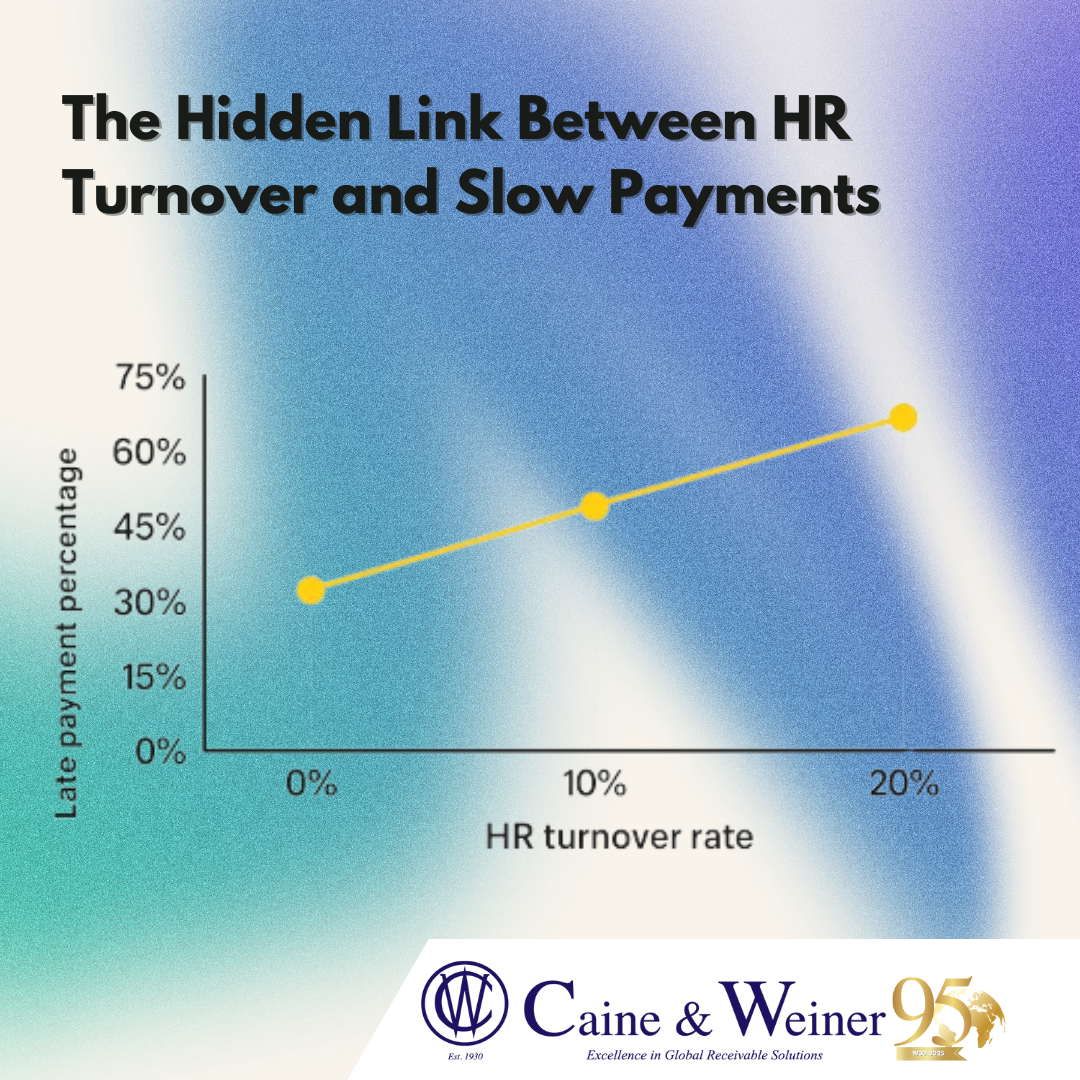
The Hidden Link Between HR Turnover and Slow Payments
Caine & Weiner’s internal analysis of multi-industry clients shows:
- Companies with high HR turnover experience a 33–47% increase in late payments within 90 days.
- AP teams with staffing shortages are 2.3x more likely to lose or misroute invoices.
- 60% of payment delays tied to “system issues” or “administrative bottlenecks” actually originate from staffing gaps—not technology.
In industries with already-thin operational margins, such as e-commerce and service businesses, these delays compound quickly.
But the most telling statistic? When HR turnover exceeds 20% annually, slow-pay accounts rise by an average of 29%. That’s not a coincidence. That’s a pattern.
How HR Turmoil Disrupts the Entire Payment Chain
When HR is understaffed or experiencing high turnover, the disruption cascades into AP in several predictable ways:
1. Broken Approval Workflows
New employees don’t always know:
Who approves what? How to route invoices? Which departments handle bill disputes? and What forms are required? One missing signature can delay payments for weeks.
2. Outdated Vendor Records
HR turnover often delays updates to: Contact lists, Email forwarding rules, Vendor portals, and Authorization matrices. If invoices land in the wrong inbox, they effectively disappear.
3. Training Gaps in AP
Even the best financial systems fail when onboarding is rushed. Caine & Weiner case trends show:
Nearly 40% of slow-pay accounts correlate with AP staff who have less than 6 months on the job.
Why? They’re learning under pressure—while juggling high workloads.
4. Communication Bottlenecks
When teams are overwhelmed by follow-up emails get shorter, responses get vaguer, calls go unreturned, disputes take longer to resolve. Communication lag is one of the strongest early signs of slow-pay risk.
5. Shifting Priorities During Staffing Gaps
When internal teams are stretched, payment processing is reclassified as: “Important—but not urgent.” This mindset, even temporarily, leads to payment drift.
Why This Matters More in Service and E-Commerce
Service companies rely heavily on people—not automated systems—to run AP workflows. E-commerce companies scale fast, but documentation often lags behind.
Both sectors have:
- high employee turnover
- rapid role transitions
- heavy workload surges
- seasonal staffing fluctuations
This makes them uniquely vulnerable to payment delays driven by HR disruption. And vendors feel the impact immediately.
The Bottom Line
Slow payments aren’t always caused by cash flow issues. In many cases, they’re caused by the people who aren’t there—the HR and AP teams who left, moved roles, or weren’t properly trained.
When a customer says they’re “too busy to pay,” it’s rarely an excuse. It’s a warning.
A warning that the real issue is internal disruption.
A warning that payment timelines are about to slip further.
A warning that vendors need to step in early—before “slow-pay” becomes “no-pay.”
For credit managers today, tracking HR turnover impact on payments is no longer optional. It’s one of the most important early-risk indicators you can monitor.